Internationalisation in African VET Schools
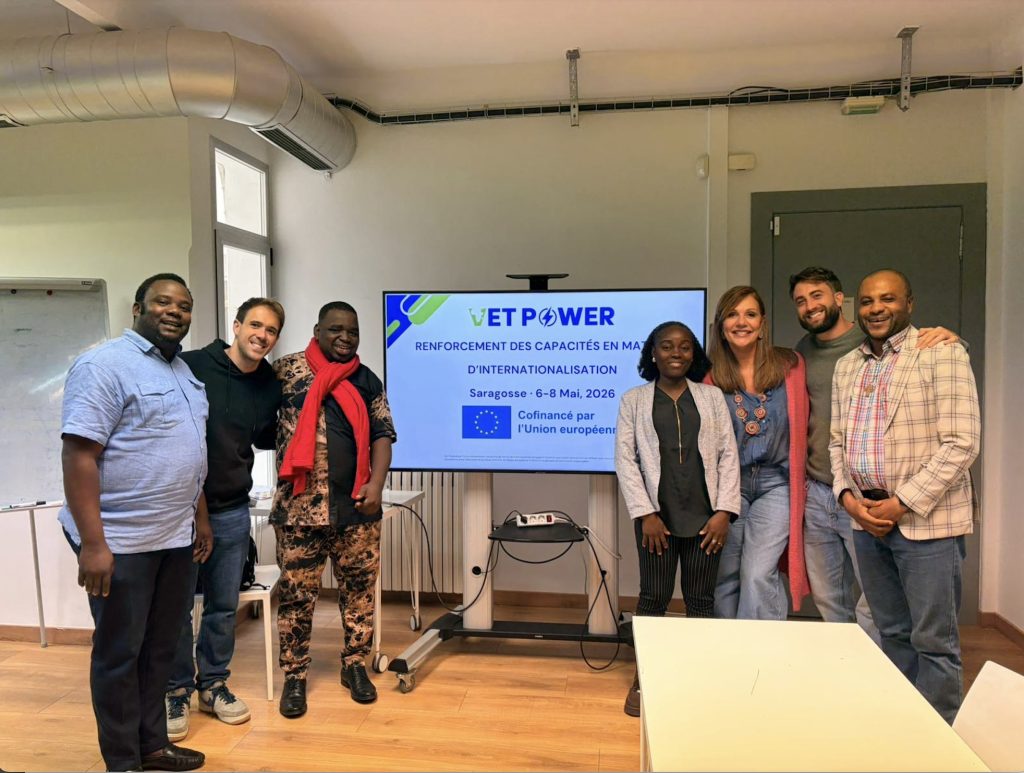
From 6 to 8 May 2026, MUNDUS hosted in Zaragoza a focused Capacity Building activity on internationalisation within the VET-POWER project. This training was designed to support the African partner schools from Benin, Cameroon and Burkina Faso in understanding how internationalisation can become a practical institutional strategy, directly connected to student mobility, work-based learning, school partnerships and long-term quality improvement.
The activity started with a theoretical session on the internationalisation of VET centres. MUNDUS introduced key concepts, models and practical tools inspired by previous international cooperation experiences, including the SAAM methodology and MUNDUS’ own experience in managing incoming and outgoing mobility programmes. The session helped participants reflect on what internationalisation means beyond mobility: governance, preparation of learners, cooperation with companies, staff roles, risk management, communication with families and follow-up after the mobility.
The second day was dedicated to study visits and job shadowing. Participants first visited the Salesian School Nuestra Señora del Pilar in Zaragoza, where they discovered the school’s educational environment and its electricity department. This visit was especially relevant for VET-POWER, as the project focuses on the electricity sector and includes future student mobilities involving learners from each African school, accompanied by a teacher.
The group then visited ILUCALFI, a local company connected to the electricity and lighting sector, where MUNDUS students carry out work-based learning placements. This gave participants a concrete view of how host companies are selected, how placements are organised and how cooperation between the school, the company and the hosting organisation can support the learning process. Finally, partners visited one of the accommodations used by MUNDUS to host international students. This allowed African partners to better understand the full hosting process: arrival, accommodation, student support, monitoring and day-to-day accompaniment.
These visits were not only observational; they were also a practical learning experience. For the schools whose students will later travel within VET-POWER, especially the students from Burkina Faso who will be hosted by MUNDUS, the activity provided a clear picture of how their learners will be welcomed and supported in Zaragoza.
On the final day, participants reviewed the internationalisation action plans of each African school. Through a practical workshop, they identified priorities, needs and commitments for the development of Deliverable D4.1. The activity concluded with a shared reflection on how each institution can transform mobility experiences into a broader internationalisation strategy.
Key outcomes:
The training helped schools connect internationalisation with concrete institutional planning. It provided practical examples of hosting, company placements and student support. It strengthened the preparation of future VET-POWER mobilities. It also supported each African school in defining priorities for its internationalisation action plan.

Privacy Policy
Cookie Policy
Disclaimer
projects.global@scformazione.org

Funded by the European Union. Views and opinions expressed are however those of the author(s) only and do not necessarily reflect those of the European Union or the European Education and Culture Executive Agency (EACEA). Neither the European Union nor EACEA can be held responsible for them.